The summer before I transitioned from day school to boarding school (in what my children delight in reminding me was the last century) the eighth grade dormitory burned to the ground. The school’s response was to farm the boys out to local boarding houses. It was my bad luck to be placed at Mrs. Mullaney’s.
Mrs. Mullaney was a high-strung and devout Civil War widow who seemed to view the twelve of us as part of her agonizing road to heaven. She would frequently, apropos of nothing, look at each of us in turn and declare, “The Lord is testing me.” If we did anything more active than silent study, she would begin crossing herself and shouting the rosary. I am a lifelong Presbyterian, but to this day I know several Catholic prayers by heart.
It seemed to me that boys at other boarding houses had an easier time of it. Neither electricity nor indoor plumbing had reached Mrs. Mullaney’s drafty house. It was a mile away from campus, and to get to class we had to walk on wagon-rutted roads that varied between muddy and icy. But all of this would have been bearable were it not for Matthew Abernathy.
Matthew Abernathy was tall and handsome. He shaved. (This was proven to me by his roommate, who allowed some of us into the room to admire the tiny hairs he had left in the washbasin.) He was good at sports and school, and he made friends easily. To this day I don’t understand his unkindness. In my experience, cruelty to others arises from insecurity. But Matthew Abernathy was the most popular boy at that school, with a charmed future ahead of him, and still he went out of his way to be nasty to me and John.
He was quick with a pinch or a snide remark, but his real gift was for leadership. Boys who were perfectly pleasant individually grew cruel around Matthew. My roommate Walter would help me with my math, but once Matthew entered the room he would tumble over other boys to insult me. Our housemates would pitch stones and pine cones at our backs on the walk to school, or crowd together to push us into piles of manure in the road. They hid textbooks and shoes. They collaborated on love letters supposedly from girls we had mentioned, doused with Mrs. Mullaney’s perfume. Their goal was Matthew’s approval. Their trophy was his laughter.
John and I were easy pickings. Both of us would have given anything to be like the other boys. Our defects held us back. Mine was my stammer. I had other flaws, of course, but all of them, I felt, could be traced back to the way I spoke. I was certain that if the words would just come out smoothly I would be less lazy, kinder to my sister, and better at algebra. As it was, my ability to spend a full minute on a single syllable was the source of much mockery. The boys called me “P-p-p-paul.” When I would get stalled pronouncing a word, I could sense impatience from both my classmates and teachers.
“Spit it out,” Matthew would say. Or, “Don’t make a meal of it.” He used both versions fairly often, and they always managed to draw fresh laughter from everyone in the boarding house. John was the exception.
John’s main crime was that he was what we called “country.” His whole town had raised the funds to send him to our school; despite his academic prowess he used “them” as a subject and sprinkled around the word “ain’t.” He knew what frogs tasted like. He was unsophisticated enough to strike up conversations with the woman who came in to do the washing. In that boarding house, where my only goal was to be invisible, his friendship was both riches beyond belief and an additional source of mortification.
The night of the séance, John and I were sitting on the porch, as usual. Our conversations were ships steered by John. I, as the passenger, would make facial expressions, or utter (“Spit it out”) the occasional noise of agreement. That night’s topic was most likely John’s weightiest interest, baseball, but I don’t remember for certain — maybe we were talking about girls. We could have been making fun of the Latin teacher. I remember it was a spring evening, and it was a pleasant discussion. Most of all I remember the wind.
Mrs. Mullaney liked to keep the front door propped open with a brick, in a vain attempt to cleanse the house of the odors of adolescent boys. That night it was so windy that the front door thudded back and forth between the brick and the wall, bumping the brick an infinitesimal degree forward with every impact. It was a warm night, but I remember I had turned up my collar and had to occasionally turn my face away from dirt flying through the air from the front yard.
I do remember that whatever the topic, John was mid-word when a sudden slamming sound and the shouts of male voices came from inside.
John and I exchanged a look and went racing through the open door into the house. We were at full speed when we reached the parlor, but Matthew Abernathy arrived at the same time. We held back to let him race into the room before us. We were right behind.
Three boys, my roommate Walter among them, were on their feet, breathing heavily and staring at a table that lay on its side on the carpet. When they saw us newcomers, they all began shouting at once.
Matthew held up a hand. “Do you want Mrs. Mullaney in here?”
The boys lowered their voices. “We were at the table–” “Spirits!” “We didn’t do anything, it just–” “– the Devil!” “It was spirits, I tell you!”
“You was Table Turning?” guessed John.
“Yes, and look!” Walter cried, pointing at the knocked-over table.

John nodded. “Spirits,” he diagnosed.
“Malarkey,” said Matthew. It was one of Mrs. Mullaney’s words, and he said it with her accent. Normally it would have been a reliable laugh. But this was not a normal night.
John turned to the other boys, who were still panting and rubbing the goosebumps from their arms. “Do you want to do it again?”
I felt my stomach sink. I had been preparing to excuse myself from the room, and Matthew Abernathy’s presence.
A boy named David announced he was done with table turning and stormed off to his room, muttering about the book of Deuteronomy. “I shall take his place,” John said. He and the two others righted the table. And then, casually, John said, “Paul, take a seat. It will work better with four.”
I lowered my head and grabbed one of Mrs. Mullaney’s mismatched Windsor chairs. I knew nothing of Spiritualism. Furthermore, I had no idea that John did. I felt I should have known this about him, as his only friend, but he had never mentioned it. I grew a little irritated thinking of all the monologues about baseball I had sat through.
I had barely arranged myself at the table when Matthew came over, dragging a chair of his own. “Make room.”
“It will work best with four, not five,” John said. Then he turned to me and explained how to place my fingertips against the tabletop, leaving Matthew standing there holding his chair. “Like you’re trying to hold the table underwater,” John said. Walter and Francis, the fourth boy at the table, agreed that that was just how they had done it. I followed their lead, but I watched Matthew out of the corner of my eye. He looked stung. I braced myself for the snide comment, the rallying of the boys. But he just put down the chair and leaned against the wall with folded arms.
The coal stove had burned out, so the room was chilly. A steady current of air blew down the hall from the open front door, making the curtains shimmy and the gas lights fling shadows around the room.
“Close your eyes,” John said.
I did, feeling foolish and defenseless.
And then the table wobbled. I could hear a faint thunk as one of the legs bumped against the floor.
I caught my breath and held very still.
It wobbled again.
I kept pressing down, but I opened my eyes slightly. The other boys around the table were all in the same position as me, and their expressions ranged from reverent to terrified. Matthew was standing on tiptoes to see our fingers.
Then the table began rattling back and forth, vibrating with increasing intensity until John said, “Open your eyes.” We pulled our hands away and grinned at each other, all of us, even me. John declared, “Gentlemen, our house is haunted.”
Walter, Francis, and I gravely acknowledged that this appeared to be the case. Walter was pretty sure he had felt a presence. I shakily wondered if I would recognize a presence if I felt one.
“One of you did it,” said Matthew Abernathy. “You pushed it with your fingers.”
John asked us if one of us had rocked the table, and we all vehemently denied it. He looked at Matthew and said simply, “It was a spirit.” It seemed to me at that moment that John disagreeing with Matthew Abernathy was the bravest thing I had ever seen.
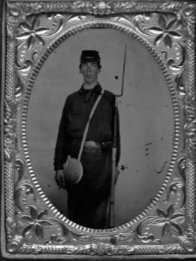
Matthew opened his mouth to respond, but John cut him off. “And I am fairly certain I know who the spirit is.” He nodded his head at a tintype on the wall. The image was of a boy not much older than us: Mrs. Mullaney’s husband. It was taken shortly before he went off to fight, and die, in the Civil War.
“Mr. Mullaney?” Francis breathed.
“Think of it,” said John. “He got killed in the war. His spirit has wandered the battlefields for years, and when he finally makes it home, he finds his wife living with twelve strangers.” What he must think of her, I thought.
“Poor Dan,” said Walter.
“His name isn’t Dan,” Francis said, and there was a lively discussion about Mr. Mullaney’s Christian name (Matthew agreed it was Dan) that ended with Francis saying, “His name was Francis. She tells me that frequently.”
“Do it again. I want to try,” Matthew said. “P-p-paul, give me your seat.”
I began to get to my feet, but John grabbed my arm and held me in place. “I got a better idea,” he said. “Let’s commune with the dead.”
We stared at him. I felt my face getting hot, certain that Matthew was glaring at me. But when I dared glance his way, he was watching John, too.
“A séance?” squeaked Walter.
John nodded. “Fetch a candle,” he told Francis.
“Can’t I sit, too?” asked Matthew. I could hear the wheedling tone to his voice.
The rest of us looked to John. He considered. “You can serve as the recording secretary,” he said. “Get paper and pencil.” As Matthew turned for the door John hissed, “Do not alert Mrs. Mullaney!”
While Matthew was gone Francis and Walter fought over who got to light the candle. Finally one of them lit the match. In the glow of the flame, John’s face looked satisfied. “In the center of the table,” he directed, as though he were accustomed to ordering people around.
Worry was growing in my gut. For the moment, John had dethroned Matthew. I was enjoying it. But I couldn’t help wonder what would happen to John at the end of the night, when Matthew took charge again. And, more concerningly, would I get dragged down with him?
Matthew rushed back into the room, a notebook and pencil in hand. “Get ready to put out that light,” John said to him. I ducked my head, waiting for Matthew’s snarled response. But he just moved closer to the sconces over the mantel.
“All right,” John said. He instructed the three of us to put our hands on the table, and then he said, “Abernathy, cut them lights now.”
I placed my splayed fingertips back on the smooth wooden tabletop. The candle’s glow only reached as far as our faces. None of us closed our eyes this time. I could hear the sound of Matthew stumbling to a chair, and then papers flipping as he opened his notebook.
John began. “We come together tonight to invite the spirit present to speak to the living. When you are ready, Spirit, let us know by wobbling this here table.”
I got chills. Apart from the howling wind outside, there was dead silence in the room. Then I heard it: a small wooden thunk of table leg against floor.
We boys at the table looked around at each other with little smiles. “What is your name?” John intoned. “Tell us when we get to the right letter.”

We kept our fingertips on the tabletop while he called out the letters of the alphabet sequentially. John was almost all the way through the alphabet before the table wobbled. Then he started over again. It took a while. Each time he moved on to the next letter I felt disappointment growing in me; the deeper he got into the alphabet the more certain I was that the spirit had abandoned us. Each time the table wobbled, hope returned to my heart. After the eighth letter, John loudly whispered, “Abernathy, what do we have so far?”
Matthew got up from his seat and brought the paper closer to the candlelight. “P-F-H-H-E-L-R-B.”
Those of us at the table looked around at each other.
Matthew grinned. In a country accent he said, “Well, that don’t spell Francis.”
“Maybe he can’t read,” suggested Walter.
“You may be right,” John said grimly. The four of us conferred. To my great relief, Matthew Abernathy made his way back to his seat in the dark.
“We got a new plan, Spirit,” John announced after another minute. “We’re going to ask you questions and then say yes or no. You shake the table on yes for yes, and no for no. Do you understand? Yes?”
The table wobbled.
I could sense movement somewhere in the darkness of the room. “It’s a séance,” Matthew whispered, and then I heard footsteps running down the hall to the stairs.

“Are you Francis Mullaney, who dwelt in this house in life?” called John. “Yes?”
thunk
“What do you want?” said Walter. Francis and John hissed at him for asking the wrong kind of question and for talking out of turn. (“I shall do the talking,” John said.)
I heard the sound of multiple sets of shoes on the stairway, and then there were whispered voices and bodies bumping into the room. In the dark it sounded like the entire boarding house population had joined us.
“We’re talking to the spirit of Francis Mullaney,” John announced to the room. “You may stay if you’re quiet.”
The other boys shushed each other.
“Francis Mullaney,” John said loudly, “as we was saying, we want to know why you’re here. Do you want to hurt us? Yes?”
A breathless silence.
“No?”
thunk
A dozen boys exhaled at once.
“Francis Mullaney, do you need our help? Yes? … No?”
thunk
“Francis Mullaney, do you want to help us? Yes?”
thunk
“Oh,” all the boys in the room exclaimed at once.
The four of us at the table put their heads together. Matthew shouted a suggestion. John scowled, but it was met with so much enthusiasm from the room that John finally acquiesced and called out, “Francis Mullaney, is there a hidden treasure?”
The table wobbled on no.
John said, “Francis Mullaney, are you bringing us a warning? Yes?”
thunk
“Oh!” shouted the boys. Despite the breeze, the room was growing warm from all the bodies in it.
“Francis Mullaney, is the warning for your wife? Yes? … No?”
thunk
“Francis Mullaney, is the warning for us? Yes? … No?”
thunk
The entire room sighed.
The four of us looked at each other for a moment, shadows fluttering across our faces. I could feel the eyes of the entire room on us.
I was trapped. John had dragged me into this little stunt against my will, and now I was going to have to pay the price alongside him. If I were smart, I thought to myself, I would push away from this table, slip into the darkness with the others, leave all the attention to John.
John called out, “Is the warning for one of us? Yes?”
thunk
“OH!” the boys shouted.
“What is it?” called Matthew.
“That’s the wrong kind of question,” Francis seethed. Walter muttered something, but I couldn’t make it out. Other voices in the room shouted suggestions. The boys were between me and the door. I felt smothered by their noise. John looked at me, grinning a little. I hated him. I decided to get up and walk away, disappear into the darkness with the rest of them. I would do it. I would save myself.
I was pushing my chair away from the table when John shouted, “All right! All right!” The room fell silent except for the moaning wind. I froze in my seat. He cleared his throat. Even in the limited candlelight, I could see the sweat on his face.
John called out, “Francis Mullaney, is someone in danger?”
Simultaneously, three things happened. The front door slammed shut. The candle blew out, leaving us all in darkness. And a voice shrieked, “What the devil?”
A room full of boys screamed.
I leapt to my feet. In the dark I could hear furniture getting knocked over and bodies bumping into one another. Walter rushed to my side and clutched my arm. “The lamp! The lamp!” someone sobbed. Through the bumbling and swearing I saw a tiny flame appear by the fireplace mantel. It raised to the height of the gas sconces, and then the room blossomed into view.
John still sat at the table, his fingers spread out and pressing down. Every other resident of the boarding house was on his feet, looking terrified.
Mrs. Mullaney, in her nightgown and cap, was in the doorway.
She stood very still, her face red. Just as I recognized her and began to relax, she began screaming. “You heathens! You’re trying to wake Francis Mullaney? MY Francis?”
None of us would meet her eyes.
“He never lived in this house, you idiots! He died when he was seventeen years old. You think we owned a house with seven bedrooms when we were seventeen years old?” Mrs. Mullaney stared at us. “What use is that fancy school to a bunch of simpletons like you? Fools, all of you.” She turned to go, and then came back into the room. “The lot of you should be expelled. I’m going to go visit your headmaster tomorrow, how do you like that?”
We were going to be sent home. I would have to face my parents, all because John had tried to take something that wasn’t his. But if I could explain that John was solely to blame, maybe I could save the rest of us. And maybe that would finally win the other boys’ respect.
I started to speak. The words on my tongue were, “Mrs. Mullaney, we’re sorry. John wanted to hold a séance. The rest of us got drawn in. It was a foolish mistake.”
What I said was, “Mm-mm-mm-”
I could feel John’s eyes on me. I refused to look in his direction. The other boys were mumbling small, apologetic noises while I struggled to speak up. With all my might, desperate to betray my only friend, I pushed my terrible voice out of my mouth, and out burst:
“Mih –!”
A few boys turned my way. Mrs. Mullaney frowned at me. I silently pleaded with her to understand, to send John home, but not the rest of us. She looked away from me, back at the room at large. “Go to bed!” she shouted. My face burned as I slunk out of the room with the others.
We were never summoned by the headmaster. Most likely, Mrs. Mullaney did not report us at all. But her disgust with us was palpable for months. I heard her mutter as she went about her work, hissing foolish while she stirred the soup, snarling shame as she swept. Among the boys, any maintenance issue or misplaced item for the rest of the semester was jokingly blamed on the ghost of Francis Mullaney.
Despite the séance’s utter failure, John became an authority within the house on otherworldly matters. Out of Mrs. Mullaney’s view the boys asked John to throw bones and read tea leaves. He always complied. His decidedly average rate of accuracy did not sway anyone’s opinion.
John’s mystique, according to the rich boys in our boarding house, was due to his rural poverty. Even Matthew Abernathy spoke longingly of John’s luck growing up among haunted haybarns and occult symbols. It afforded John, if not popularity, a certain amount of respectability. It was an umbrella he shared with me.
By the time we moved into the new dormitory in tenth grade, we no longer had to worry about our belongings disappearing or being shoved up against the walls, which were still sticky with wet paint. Within the wider school population, Matthew Abernathy left our orbit. John’s magical reputation followed us into our new sawdust-smelling building. Boys we hardly knew came to him for blessings and love spells.
The night before graduation, John conjured success for our entire class. We stood in a circle while he produced a dinner roll from behind his back. Then he had each of us eat a seed from it and repeat some magic syllables. I did it, too, although John uttered my words for me. Only I saw him wink as he said them.
So in the end, John’s flaw became an attribute. And mine, too.
John never learned of the betrayal in my heart. We exchange Christmas letters to this day. Only I know of the hatred I felt for him that night, and that our friendship endures for one reason: because I could not, in fact, spit it out.