You’re dead. That’s no reason to stop working! You may be a cadaver, but your earning potential lives on.
Your professional mentor for this new stage of your career will be Elmer McCurdy. He lived from 1880 – 1911, but he was employed until 1976. His post-death career was filled with highs and lows, and it took him from carnival sideshows to a national monument to the hottest show on TV. And most importantly, he kept making money for his employers.
Take lessons from Elmer, and you, too, can live the American Dream and work forever.
Elmer McCurdy’s Career Tip #1:
Follow Your Passion, and Success Will Follow
Like Van Gogh, Elmer McCurdy was never appreciated in his lifetime. Unlike Van Gogh, Elmer was an untalented screw-up.
In life, Elmer’s drinking got him fired from every job he had. (Except mining — contracting tuberculosis put the kibosh on that one.) Employment didn’t really work out for him. But Elmer had a back-up plan.

These were the days of infamous train robbers. He would have grown up hearing tales of Jesse James and Bill Doolin, founder of the Wild Bunch. When earning a living did not work out for Elmer, a life of crime seemed reasonable. He set forth to become a notorious outlaw.
He teamed up with a rag-tag gang of thieves. A stint in the army had taught Elmer how to use nitroglycerin, so his specialty was opening safes. He was … not good at it. On one train he blew up a safe and incinerated all the cash inside. (He and his colleagues got away with some partially-melted silver coins.) In another robbery, he targeted a train carrying $400,000 … and ended up robbing the wrong one. He and the boys split $46. Local newspapers made fun of them.
That was Elmer’s swan song as a robber, and also as a breather. He left the crime scene and went to the ranch of a local acquaintance. After a night of drinking, he passed out in a barn. That’s where a posse of sheriff’s deputies found him the next morning. In the October 8, 1911 edition of the local paper, one of the deputies gave an account of the harrowing gunfight that finally ended with the law victorious. In reality, Elmer McCurdy died of a single gunshot wound that occurred when he was lying down, presumably in a drunken stupor.
Elmer McCurdy was dead. But career success was just around the corner.
Elmer McCurdy’s Career Tip #2:
Do What You Love
Elmer McCurdy died as he preferred to live: unconscious, with poison running through his veins. Now it was time to parlay those skills into a career.
Unlike Elmer, Joseph L. Johnson was good at his job. He was the local undertaker, a hardworking man with a penchant for arsenic-based embalming fluid. He pushed it through the train robber’s veins, then gave him a shave and dressed him in a suit. Then he waited for Elmer’s friends or loved ones to claim him. Nobody did. Elmer could have been buried in a pauper’s grave, but Johnson was a businessman: He wouldn’t release the body, not until he was reimbursed for his labor and expenditures. Johnson shoved Elmer into a back room of the funeral home, presumably while grumbling, “Arsenic doesn’t grow on trees, you know.”
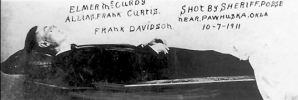
In the back room, Elmer rested in peace for awhile. But there’s no money in peace. It wasn’t long before Johnson the undertaker put Elmer to work.
Johnson dragged Elmer back to the front of the funeral home. He took back his suit and dressed Elmer’s cadaver in street clothes. Then he propped the perfectly-preserved body in the corner and placed a rifle in Elmer’s hands. Johnson called him “The Bandit Who Wouldn’t Give Up” and began charging a nickel to see him. Elmer became a popular local attraction.
And that’s a lesson you can learn from Elmer McCurdy. In death, by doing what he loved — remaining unconscious, his veins filled with poison — he pulled in the nickels. After a wasted life, he was finally gainfully employed. In fact, he was on the road to success.
Elmer McCurdy’s Career Tip #3:
Reputation is Everything
Elmer stayed at the funeral home for five years. There is no record of how much money he made the undertaker, but he was popular enough that when the carnival passed through, the owner tried to buy him. Johnson declined, unwilling to give up his side hustle.
Not only was Elmer known as “The Bandit Who Wouldn’t Give Up,” he was also promoted as “The Mystery Man of Many Aliases,” “The Oklahoma Outlaw,” and “The Embalmed Bandit.” This rebrand as a notorious outlaw made him locally famous. But that was about to change.
After five nickel-filled years, the McCurdy-Johnson partnership broke up. It was due to a man called Aver McCurdy. He contacted the local sheriff, and an attorney, and finally Johnson: He was looking for his brother Elmer, he said. The family wanted to give him a proper burial in San Francisco.
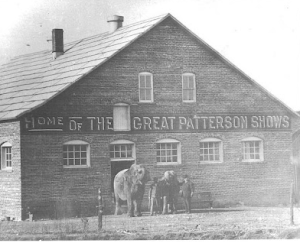
Probably inspired more by the attorney than sentiment, Johnson released the body. Elmer was taken to the train station by Aver McCurdy. This was an alias, of course; Elmer’s “brother” was actually the co-owner of The Great Patterson Carnival Shows.
And this, dear dead person, is the third lesson you can learn from your mentor: Reputation is Everything. Because of his great branding, Patterson had heard of the embalmed bank robber. New professional opportunities, and also kidnapping, opened up for Elmer.
Instead of San Francisco, the body was shipped to the carnival in Kansas. Elmer McCurdy was about to go on tour.
Elmer McCurdy’s Career Tip #4:
Know Your Worth
Elmer McCurdy isn’t the only corpse to go on tour, of course. Posthumous scheduled appearances have been made by Eva Peron, Vladimir Lenin, and someone who claimed to be John Wilkes Booth (presumably because he liked to be spit on).
In Elmer’s case, he wasn’t a celebrity in life. It took being embalmed for fame, success, and reputation to come to him. But he had them now, as an attraction at The Great Patterson Carnival Show. He was billed as “The Outlaw Who Would Never Be Taken Alive.”
Sure, it was exciting, traveling the country, being gawked at by Americans from all over. He could have been satisfied with that. But Elmer McCurdy knew he was meant for greater things. After six years amid the grit and sleaze of carnival life, it was time for his star to rise further.
In 1922, one of the carnival workers used him as collateral for a $500 loan, and then defaulted. As a result, Elmer ended up in the hands of entertainment company owner Louis Sonney.
Another lesson you can learn from Elmer: Know your worth. (In his case, ten thousand nickels.)
Thanks to a carny’s poor choices, Elmer was headed to Louis Sonney’s Museum of Crime.
Elmer McCurdy’s Career Tip #5:
Celebrate Your Successes
22 years after his death, Elmer had finally made it to the big leagues. In the traveling Museum of Crime, he was propped up beside legends like esteemed robbers Jesse James and Bill Doolin. It was high times for McCurdy.
The road can be a lonely life for a corpse; the other criminals on the tour were wax replicas. But McCurdy didn’t judge, and it served him well. Wax dummies would be his companions for the rest of his career.
His glamorous new life was not without struggle. Arsenic, it turns out, is not a long-term solution to decay. The effects of embalming had hardened and shriveled his skin, causing him to shrink. By now, at the peak of his career, Elmer McCurdy looked like an unwrapped mummy.
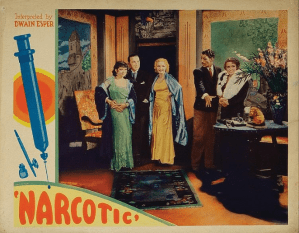
But Elmer had the confidence to use this quality to his advantage. In 1933 he made a Hollywood connection. Narcotic is by all accounts a terrible movie about drug use. (The film’s thesis: it’s bad.) For the premiere, the director placed Elmer in a corner of a theater lobby. Elmer’s first acting credit was “Dead Dope Fiend.”
Lesson: You’ve got to celebrate the good times, because they do not last forever.
Elmer was dead, but he had steady work. In America, this is what is known as success. But change was coming.
In 1949 Louis Sonney died. Elmer’s next position? Stored in a warehouse. For fifteen years.
Elmer McCurdy’s Career Tip #6:
Stay Ready for Your Comeback
When bad times come, and they will, stay positive and ride them out. That’s just what Elmer McCurdy did.
Sonney’s death left Elmer unemployed. After 38 years of achievement, he hit rock bottom. Languishing in a Los Angeles warehouse, he could have accepted defeat. He could have gotten comfortable there in the dark, hanging out with his wax buddies from the Museum of Crime, and never made money again. Instead he held onto his confidence and prepared for opportunity’s return.
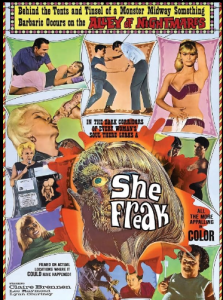
And when Hollywood finally came calling, Elmer was ready.
1967 saw the release of The Graduate, In the Heat of the Night, and Bonnie and Clyde. Also a piece of shit called She Freak. That’s the one Elmer was in. It wasn’t a large role. It did not catapult him to stardom. But it was enough to remind people of his existence.
Lesson: Stay ready. You never know when opportunity will strike.
The next year Elmer, along with the wax figures, was sold to Spooney Singh, owner of the Hollywood Wax Museum. He was back in show business, baby.
Elmer McCurdy’s Career Tip #7:
Accept Feedback
The late sixties were an eventful time in America. Beloved leaders were assassinated, the Mansons rampaged through the Hollywood hills, young men were being drafted for a futile war. It was a time of poor choices, is what I’m saying.
And amid the tumult and madness, someone decided that what the nation needed was wax figures of criminals at Mount Rushmore. The reasons are lost to time. (Money. And probably drugs.) For this national display of bad guys, Elmer McCurdy and some of his buddies were tapped.
It was stupid, but it was an honor. Except the same brain trust that came up with spotlighting crime at a national monument also placed Elmer and the wax figures outside.
Elmer had faced many challenges in his posthumous career, but this was the first time he was attacked by nature. Battling the elements is a young corpse’s game. The wind at Mount Rushmore blew off some of his fingers and toes, along with the tops of his ears.
When he returned to Hollywood, Spooney Singh pronounced Elmer “gruesome” and “unrealistic-looking,” and took him off display. It was difficult feedback to receive.
But Elmer was a survivor, figuratively. And he wanted to work. That can-do attitude kept him going. And it would lead him to the strangest chapter of his career.
Elmer McCurdy’s Career Tip #8:
Adapt to Changing Times
After the Mount Rushmore debacle, Elmer found himself up for sale again. Singh was now calling him the “Thousand-Year-Old Man.” It was a little insulting, but Elmer endured it. It was still honest work.
It was around this time that people started thinking he was a wax dummy. It’s unclear whether Spooney Singh or Elmer’s next buyer made the mistake, or if it was an intentional re-brand. In any case, Elmer officially lost his humanity in the early 1970s.
During his long deathtime, the field of entertainment had changed. When Elmer was sold to a carnival, he thought he knew what to expect. But his old gig, sideshow spectacle, was unavailable — sideshows had become extinct. People had fun in different ways now.
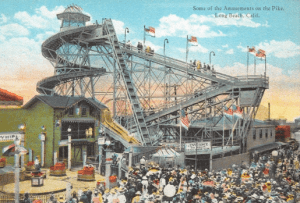
So the “Thousand-Year-Old Man” got a job in a funhouse.
The Pike amusement zone in Long Beach, California featured a clattering wooden roller coaster, food concessions, and those games you pay money to not win. Rock music would have been blaring through transistor radios, and every time you inhaled you would have smelled fried dough and smoke of various kinds.
The Laff-In-The-Dark funhouse was one of those poorly-lit rides that suddenly veers your cart at rubber skeletons and paper mache coffins. (More like Whiplash-In-The-Dark, amirite?) Elmer’s role was to jerk around as the riders swerved towards him, thanks to a machine that shook his body all day long.
But Laff-In-The-Dark did not fully appreciate Elmer. After awhile the staff decided he wasn’t even cool enough to jiggle at stoned teenagers, so they demoted him to background player. The employees covered him with neon paint and hanged him from a gallows.
And because of his work ethic, Elmer adapted. He saw the humor in it: he was a train robber, after all — it was about time he got hanged. He decided to be the best dangling “wax dummy” Long Beach had ever seen.
Tragically, his posthumous career was about to end. Hollywood was once again coming to Elmer.
Elmer McCurdy’s Career Tip #9:
Expect the Unexpected
In December of 1976 The Six Million Dollar Man filmed an episode at The Pike.
(Author’s note: If, like Elmer McCurdy, you weren’t alive during the 1970s, I don’t think I can properly explain this television show to you. The main character was an astronaut who died in a test flight, but was rebuilt with a bionic eye, arm, and legs. The surgery gave him super sight, strength, and speed, which was indicated by slow motion.

Here are some key points about the show:
- The main character was a secret agent who was partial to red jumpsuits.
- All the female scientists looked like cheerleaders.
- Bigfoot appeared in five different episodes.
In a time when there were only three TV channels, this batshit spy show with a dubious grasp of technology was a mainstream hit. It spawned a spin-off (The Bionic Woman) and an action figure and a lunchbox that were exceedingly popular in my social circle. In 1976, it was #7 in the Nielsen ratings. Its influence extended to the schoolyard, where I cannot overemphasize the number of kids running around in slow motion every day, making sound effects with their mouths.)
The episode of The Six Million Dollar Man filmed at The Pike wasn’t one of the Bigfoot ones, unfortunately — it was something about a German scientist hiding a missile beneath carnival rides — but it was a big deal. Part of it was filmed in the funhouse. Elmer had never experienced television, but he knew he wanted in.
Laff-In-The-Dark had to be rearranged for filming. While a prop guy was moving one of the wax mannequins, the one that had been spray-painted and hanged from a gallows, he accidentally knocked off its arm. (And there is a 100% chance someone nearby said, “We can rebuild him. We have the technology.”) The unnamed crew member went to screw the arm back on, and realized he was looking at human bone.
And so the police caught up with Elmer once again.
At the Los Angeles coroner’s office, an autopsy took place. Dr Choi, the coroner, looked at the shriveled fifty-pound body on his table — spray-painted, dried up, missing fingers and toes — and set to work trying to identify it. He discovered tuberculosis scars in the lungs. He found part of the bullet that had killed him. He identified a type of embalming fluid not used for some time (because, again: IT HAD ARSENIC IN IT). And when he went to examine the teeth, he found that Elmer’s mouth was full of tickets to The Museum of Crime.
An ID from Louis Sonney’s son and a photoshoot with a forensic anthropologist (who superimposed x-rays of Elmer’s skull over a photograph taken during his lifetime), positively identified him as Elmer McCurdy.
After decades of hard work, Elmer was the most famous train robber in America. The “gunslinger” was in all the newspapers. Funeral homes BEGGED to bury him. In the end, he went to Oklahoma, where he was buried on Boot Hill, among several other notorious outlaws, including Bill Doolin.
And that’s the lesson you and other cadavers can learn: With hard work and patience, you can reach your goals. It took 65 years of posthumous work, but Elmer finally became the notorious outlaw he’d always dreamed of being.

Closing Thoughts
The only thing stopping Elmer McCurdy from making another comeback is the four inches of concrete the cemetery poured over his coffin. He is retired. But his work ethic lives on in all of us.
When you see workers fighting for a fair wage, or when you hear someone remark, “Nobody wants to work anymore,” think of your mentor, Elmer McCurdy. Hardworking, willing to do anything, and satisfied with nickels, he was the employee this country needs. Someday maybe you can be, too.

You know what you should do now?
- Kill a vampire!
- Shrink a head!
- Dig up a body!
Find out HOW in the free e-book
You Done With That?



Leave a comment