
My friends, I regret to tell you that I have been feeling under the weather lately. Due to my delicate nature, this head cold has nudged me to the very brink of death. As I bravely face my own mortality, I have made plans. For you, not me.
Here in 1870s America, we upper-class ladies:
- Spend a good deal of time thinking about death
- Are talented at handiwork
- Are positively swimming in hair
Why not combine the three?
You see, while the soft tissues of the human body decompose, making them unsuitable keepsakes, hair can remain for centuries. People have been saving tresses from loved ones since at least the 1600s. There are those who collect hair from royalty and other celebrities (curls from Napoleon are especially popular). And who among us hasn’t been surprised by a clump of some ancestor’s hair upon opening an old book?
My dearest friends, undoubtedly when I die you shall find yourselves bereft. Weep not! Instead, busy your fingers and hearts doing fancywork with my corpse. When you have strands of me decorating your home, and are wearing a piece of my hair jewelry, you will not be able to avoid remembering me. Plus, this way I can continue to go to the opera.
I have come up with a few ways for you, my clever friends, to memorialize me.
WHEN I AM DEAD, PLEASE MAKE CRAFTS WITH MY HAIR

To Letitia, the most talented needleworker among you, I leave the following request: Please embroider my hair into a festive cornucopia. As you know, my ancestors came over on the Mayflower, and I dearly love Thanksgiving. Additionally, I feel that a “horn o’ plenty” will represent my generous nature, which I am famous for. Every Thanksgiving one of you may display it in your home and think of me among you. I have written a rotating schedule.
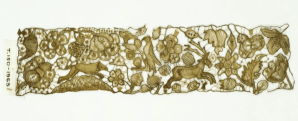
To Beatrice, who is best at sewing, I leave the responsibility of making my hair into lace. As has often been remarked, I have quite a head of hair. I am sure it is not too much to ask for a full tablecloth. My lustrous strands will make a lovely, delicate lace, and its brown color will provide a delightful hue to any dining room. Except Eliza’s. At least until her children learn some table manners.
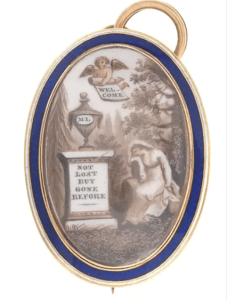
Please reserve a few strands for dear Lottie, who is untalented at sewing but decent with a paint brush. Lottie, please grind those hairs into sepia paint and make a small memorial painting for my sister. Then please deliver it to my sister and watch her to make sure she hangs it on a wall in either her parlor or bedroom. It warms my heart to think of her looking at it every day, and knowing that I was more successful at dying, too.
To the rest of you — do not think I have forgotten you! Undoubtedly there will still be a bounty of hair left over. Please make it into hair jewelry, which is equally important, but requires less talent to produce.
HOW TO MAKE HAIR JEWELRY
Everyone knows that, in life, I take a good deal of care with my appearance. Clothing is important to me (you should see what I’m going to wear to my funeral), but jewelry is where my heart will always lie. Not literally, unfortunately — as we have discussed, organs are quick to decompose.
In anticipation of my death, I have purchased a copy of Self Instructor in the Art of Hair Work by Mark Campbell. I bequeath it to you all. It seems reasonable for Millicent to hold onto it, since her house is not overly burdened with literature, presumably because her husband cannot read.
This instruction book has been beautifully assembled by Mr. Campbell, a Chicago purveyor of fine wigs and hair ornaments. In language simple enough for Millicent’s husband to understand, he explains how to make rings, brooches, and pendants using human hair. This is what I expect you to do. And when you are finished, you will have the pleasure of wearing them!
Self Instructor in the Art of Hair Work describes how to clean and prepare the hair,

How to join together the fine strands,
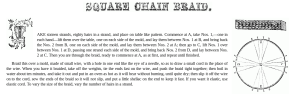
And how to create the finished product.

For some of the pieces, findings must be purchased separately. To guide you in your purchase, the back of the book contains a helpful Retail section. Kindly spare no expense. Additionally, Helen, you may be interested in browsing the section entitled WIGS! WIGS! WIGS! WIGS!
I have put together some ideas for you.
PLEASE MAKE THE FOLLOWING HAIR JEWELRY PIECES

The hair within this ring has been woven using one of the simplest patterns (page 15). It is a basic sixteen-strand braid, using eighty hairs per strand. Once you have completed the braid, you simply boil it in water for ten minutes, then dry it in the oven, then sew the ends of it and use a bit of shellac to hold it in place. It is “easy as pie,” to use one of Violet’s uncultivated little sayings, which I shall so miss when I am in Heaven.
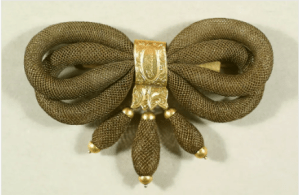
Mr Campbell’s book explains that this roundness can be achieved by braiding and weaving the hair over a dowel or stick. When the design is complete, you neatly slide out the stick and replace it with wire, and mold it into the shape you wish. What a stunning brooch it produces! I cannot wait to be worn!
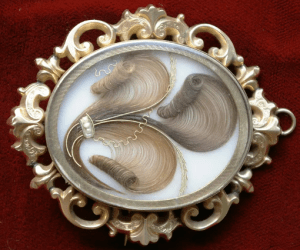
This seashell effect is produced using the palette method, which involves gluing the hair flat and then using a stencil to cut it into specific shapes. When done properly, people will take one look at this brooch and know that I had a beach house.
There is no end to the creations you can make. I think you will find you are limited only by your imaginations. I am so pleased that you are (I assume) willing to do this for me. Nothing relieves my fear of death more than thinking of each of you pinning part of my corpse to your dress each day. I knew I would be able to count on my dearest friends.

But do not simply braid my hair and cram it into a pendant. If this is the level of attention you intend to give me after my death, do not bother. You may as well just leave my body by the side of the road. Perhaps you could allow Eliza’s children to spit on me for good measure. If you are not going to treat the hair plucked from my cadaver with the respect it deserves, I would prefer you not remember me at all.

That’s better. Page 98.
If, in your enthusiasm, you begin to run out of my hair, you may add more as a supplement. DO NOT USE HORSE HAIR. Please import any additional tresses from Paris. According to Mr. Campbell, “Paris is the greatest market for the sale of human hair in the world … The amount imported to the United States in the years of 1859 and 1860 was not far from 150,000 and 200,000 pounds, which was valued at that time at from $800,000 to $1,000,000.” I require you to only use high-end materials in my memorial jewelry.
PARTING WORDS
Queen Victoria, who knows a little something about grieving, has had at least eight pieces of jewelry made from her departed husband’s hair. So in performing these acts of devotion for me, you will be in good company. You’ll be royal servants, basically.
One last request. Please harvest the material for these wondrous crafts after my funeral, but before burial. And please — and I really must insist on this — make sure I am really dead. Surreptitiously pinch me, hold a mirror beneath my nose, something.
The only thing more unsettling than waking up buried would be waking up buried and bald. It would be tragic if embarrassment was my actual cause of death.
Regarding Self-Instructor in the Art of Hair Work: This eBook is for the use of anyone anywhere at no cost and with almost no restrictions whatsoever. You may copy it, give it away or re-use it under the terms of the Project Gutenberg License included with this eBook or online at http://www.gutenberg.org
You know what you should do now?
- Drink Blood!
- Unravel a Mummy!
- Build a Wall of
Dead People!
Find out WHY in the free e-book
You Done With That?




Leave a comment