
Have you ever tried to see a ghost? Perhaps you noodled around with a ouija board at a sleepover, or got drunk and went on a ghost tour. In my story “The Boarding House Séance” some boys pass a blustery night trying to raise spirits. It’s a common human urge to try to contact those on the other side. In fact, there’s a whole religion about it.
But we may never have heard of Spiritualism without the Fox sisters. Due entirely to two young women in the nineteenth century, Spiritualism grew from a tiny sect to a major cultural and political force. And the Foxes’ phenomenal success made contacting the dead — on purpose! — a popular form of entertainment.
The lives of the Fox sisters were improbable, scandalous, and incredibly cinematic.
The First Part of Their Lives is a Ghost Story
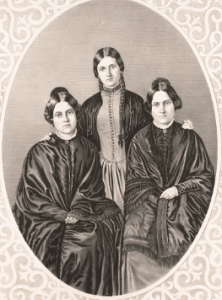
Maggie and Kate Fox were born in snowy upstate New York, in a small house that was known around town to be haunted.
In 1848, when they were 14 and 11 years old, they were kept awake one night by a curious knocking sound. Their parents heard it, too. They moved the girls to another part of the house, and the knocking sounds followed. This persistent tapping seemed to echo off all the wooden surfaces at once. And the sound wasn’t random — it seemed to respond to other sounds. Their parents came to the obvious conclusion: Demonic spirits.

Terrified, they called the neighbors in as witnesses. As everyone listened, Kate asked the knocking to repeat a pattern she snapped with her fingers. It did. The girls asked the spirit their ages. It was able to count out the correct number of raps. Quickly the people in the room devised a laborious system for spelling out letters of the alphabet: One of the neighbors, Mr. Duesler, would call out a question. Everyone gathered would listen to the response.
Slowly, it emerged that this disembodied spirit had an earthly identity: a thirty-one-year-old peddler who had been murdered for the sum of five hundred dollars and then buried beneath the Foxes’ house by a previous tenant.
-The Paris Review
In the following weeks the neighbors tried to determine which former resident had killed the peddler. After much discussion, they determined it was a man named Bell. A group of them found his new home and accused him. While Bell’s guilt was never proven in court, for the rest of his life he had the reputation of a murderer.
The children were not part of the posse. To protect them from demonic forces, their parents sent them away from the murder house. The girls went to live with adult siblings: Maggie with their brother, Kate with their sister Leah.
But the knocking? It followed them.
The Second Part of their Lives
is a Girl Power Success Story
Stories of the girls who communicated with the spirit world spread around the region. Wherever the girls went, the knocking occurred. They found supporters in friends of the family, and then their following spread.
The two younger Fox sisters became a local phenomenon. But big sister Leah monetized it. She became their manager. Under her direction, Maggie and Kate popularized Spiritualism in America.

In 1849, the Fox sisters became the first mediums to charge for a performance. At Corinthian Hall in Rochester, New York, the audience requested advice on investments and love, and the spirits knocked out their response. After that, the Fox sisters became in-demand mediums.
A year later they took Manhattan. Publisher and politician Horace Greeley was in the audience, and he became a fan. The Fox sisters became more visible than ever.
Spiritualism had existed prior to this time, but it swam into the mainstream on the backs of the fabulous Foxes. The girls’ popularity led to a preponderance of psychic activity. Professional mediums popped up throughout the country. According to the Paris Review, “In 1851, a writer at The Spiritual World tallied more than one hundred spirit mediums in New York City alone.”
A common feature of Spiritualism were the “Spirit Guides” who reported back to the mediums from the other side. These advanced beings promoted things like abolition and women’s rights, values of the Quakers who were the Fox sisters’ first followers.
Greeley’s approval gave the Fox sisters entry into the finest drawing rooms in New York City. As teens, Maggie and Kate were the influencers of their day. Spiritualism, the new faith imbued with progressive philosophy, found a home among the wealthy and elite.
When Leah’s husband died, she remarried rich. A benefactor sent Kate to England to perform and spread the word, and while she was there she married a barrister. Maggie had a dramatic (and according to some sources, not entirely legal) marriage with the dashing arctic explorer Elisha Kane.
The Fox sisters had love and success. In a time when women were not allowed to have careers, Maggie and Kate were entertainers. In fact, they were stars.
The Third Part of Their Lives is a Tragedy
… yeah, you knew that was coming.
The Fox sisters, and Spiritualism, had legions of followers. But there were skeptics, too. A startling number of the spirits who appeared at their performances were celebrity dead people. After Benjamin Franklin’s spirit came and knocked to the audience, it was remarked that his spelling had taken quite a downturn since his death.

Kate was examined by the physicist William Crookes between 1871 and 1874, and he found her power to be genuine. But most scientists and scholars were skeptical. They dissected the performances and declared that the girls were making the knocking sounds with their feet, hidden by the long skirts every woman was obligated to wear. News articles and books called the Fox sisters frauds. Their biggest critic was a patent examiner named Charles Grafton Page. He was certain the girls were doing something with their toes. He felt it was unfair that he couldn’t look beneath their skirts.
Despite the doubters, the Fox sisters remained a cause celebre in Spiritualism circles. After all, the practitioners of every religion believe themselves to be oppressed. In England and the States, they retained their wealthy and notable clientele.
But despite their popularity Maggie and Kate always seemed to be short of money.
Worse still, they both had a problem with alcohol. Back during their 1850 introduction to New York, both girls were sighted drinking wine. It sounds like a case of footloose young women on the town, an antebellum Sex and the City, until you remember that they were 17 and 13 at the time.
Their drinking grew worse throughout their adulthood. After both of their husbands died young, the Foxes’ alcoholism went out of control. Kate had two sons, and she appeared to neglect them to the degree that Leah and several notable Spiritualists held what would now be termed an intervention. All it accomplished was a rift between Leah and her younger sisters.
In any case, by the time they were in their fifties, $1500 seemed like a lot of money. And when a reporter offered it to Maggie, she found it too good to pass up.
On October 21, 1888 she signed a confession that was sent to every newspaper in New York. That night, she took to the stage at the New York Academy of Music. In front of 2,000 people, she announced that the Fox Sisters, the Moseses of Spiritualism, were a hoax.
As quoted by famed debunker Harry Houdini, Maggie said, “(We found) that we could make raps with our feet – first with one foot and then with both – we practiced until we could do this easily when the room was dark … This, then, is the simple explanation of the whole method of the knocks and raps.”
And she performed a demonstration. Knocks were audible throughout the auditorium when she cracked the knuckles of her feet against the wooden floorboards.
The girls had come up with a practical joke. Religious fervor and easy money had turned it into a phenomenon.
Hoo boy. The Spiritualists were pissed.
There was the predictable shocked uproar. Many followers blamed Maggie’s backtracking on alcoholic desperation. When she recanted her confession a year later, she was unable to draw an audience to her readings.
Both sisters died a few years later, within a few months of each other. At the end, Maggie was dependent on a Spiritualist, one of the very people she had enthralled and betrayed.
The Final Twist
In the end Spiritualism was strong enough to carry on without the Fox sisters. Twenty years later, the Ouija board had been invented, and mind-reading acts took to vaudeville. By then, new people owned the Foxes’ old house in upstate New York.
In 1904 the new owners decided to do some work in the basement. When they tore down an old wall, they found a pile of bones and an old peddler’s box.
The bones were mostly from chickens. It was yet another prank. People, Maggie and Kate could have told you, will believe anything.


Leave a comment